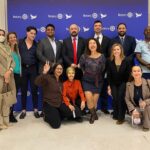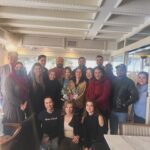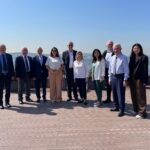
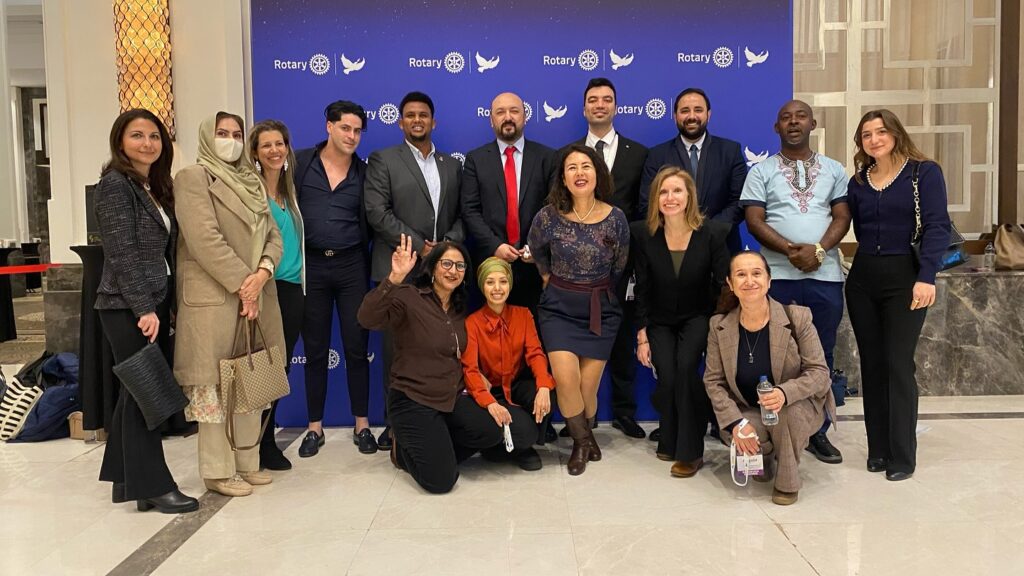
Peace Fellows with BAU Rotary Peace Center staff, Executive Director Assoc. Prof. Yüksel Alper Ecevit, Academic Director Prof. Esra Albayrakoğlu during the Presidential Peace Conference: Healing in a Divided World.
Cohort 1 in a Nutshell
Cohort 1 was the inaugural cohort of the BAU Rotary Peace Center, bringing together 13 Peace Fellows from 12 countries. The on-campus training began on February 10, 2025, and concluded in April 2025, after a 10-week intensive, multidisciplinary program.
Just one week after the fellows arrived, the Center welcomed Rotary International’s 2024–25 President Stephanie A. Urchick, along with Aide to the RI President Tom Gump and Rotary Foundation Chair of Trustees Mark Mahoney, for the “Building Peace Together” event. The occasion honored the Presidential visit and featured the unveiling of a Peace Pole at the BAU Future Campus, alongside an award ceremony for a global high-school essay competition organized by the Istanbul Rotary Club. Fellows also attended the Presidential Peace Conference: Healing in a Divided World, where the Center contributed a keynote by Rector Prof. Esra Hatipoğlu and a breakout session on Climate Diplomacy by Academic Director Prof. Esra Albayrakoğlu.
Throughout the term, fellows attended classes four days a week, combining academic instruction with field experience and cultural activities. A major highlight was a two-day conflict simulation workshop facilitated by Conflictus, in which fellows took on stakeholder roles in a fictional conflict and post-conflict society to practice negotiation, coalition-building, and crisis management.
The cohort completed four field visits across Türkiye and Northern Cyprus. In Giresun, fellows explored environmental peacebuilding and community resilience through visits to women-led cooperatives. In Ankara, they met with representatives from the FAO, ILO, the Directorate of Communications, METU, and the Embassy of Canada, and visited Anıtkabir. In Southeastern Türkiye (Mardin, Gaziantep, and Hatay), fellows engaged with earthquake relief efforts, refugee support networks, and organizations including Save the Children, Bahar Organization, and JCI Hatay, as well as women’s empowerment centers ÇATOM and KAGİDEM. In Northern Cyprus, fellows examined the dynamics of frozen conflict and reconciliation, meeting with former President Mustafa Akıncı and the TRNC Foreign Minister Tahsin Ertuğruloğlu, attending a seminar by Prof. Ahmet Sözen on the Cyprus Conflict, and visiting the closed city of Varosha.
Fellows also took part in cultural and community-engagement activities, including a perfume-making workshop with Koku Academy, a traditional weaving workshop with Fırat Neziroğlu, and a roundtable titled “Peace in Türkiye, Peace in the MENA” at BAU’s Southern Campus, hosted by Rector Hatipoğlu.
After completing the 10-week on-campus phase, fellows moved into a nine-month Social Change Initiative (SCI) implementation period, designing independent projects spanning youth leadership, inclusive education, trauma healing, and conflict prevention. Among the standout early results were Shee Kupi Shee, honored in Geneva as a top nominee for the 2025 Sasakawa Award for Disaster Risk Reduction, and Şeyda Bodur, whose women’s empowerment and employment training program launched with mentorship from BAU faculty.
The term closed with an end-of-term review meeting with the Rotary Host Area Committee and several distinguished visits, including former UN Assistant Secretary-General Nikhil Seth and Rotary Peace Center Committee member Kenneth M. Schuppert, as the Center began preparations for Cohort 2.